Social Engineering Protection for UK Businesses: Defending the "Human Surface" in 2026
26th Mar 2026
Talk to our experts today
26th Mar 2026
In an age of advanced firewalls and zero-trust networks, you might expect cybercrime to be a purely technical battle. Yet, the opposite is true. Despite massive investments in software, social engineering remains the most prevalent threat to UK organisations. According to the UK Cyber Security Breaches Survey, phishing and related social attacks affect 84% of businesses that identified a breach in the last 12 months.
The reason is simple: it is often easier to trick a human than it is to hack a machine. As we move through 2026, these tactics have evolved from clumsy emails into highly personalised, AI-powered psychological operations.
Modern social engineering is no longer just a nuisance in your inbox. It is a multi-channel threat that targets individuals – especially those in HR, finance, and executive roles – where the potential for high-value gain is greatest.
“Vishing,” or voice phishing, has reached a terrifying level of realism. Using as little as 30 seconds of audio scraped from public LinkedIn videos or company podcasts, attackers can now clone an executive’s voice with pinpoint accuracy. When a Finance Manager receives a stressed call from “the MD” at a noisy airport, their natural instinct is to follow instructions, not to verify.
Generic “Dear User” emails are being replaced by Spear-Phishing – attacks specifically tailored to the recipient using AI to generate flawless, convincing prose. Furthermore, attackers are exploiting mobile habits through Quishing (QR code phishing), where a simple scan can lead to instant credential theft or malware installation.
For many organisations, the real damage isn’t the initial contact; it’s the financial and reputational fallout that follows. Recent data shows that the average financial impact of a phishing-related breach for mid-sized UK businesses is approximately £118,000.
Beyond the immediate loss, businesses face:
Many UK businesses invest in annual compliance modules. However, knowledge does not always equal behaviour. When a staff member is under pressure or distracted, they often revert to “shortcut” thinking.
Currently, only 28% of organisations have actually tested their staff with simulated phishing attacks. Without testing, you are only seeing half the risk. Simulated campaigns frequently reveal that even in “cyber-aware” companies, click rates remain between 20% and 40%.
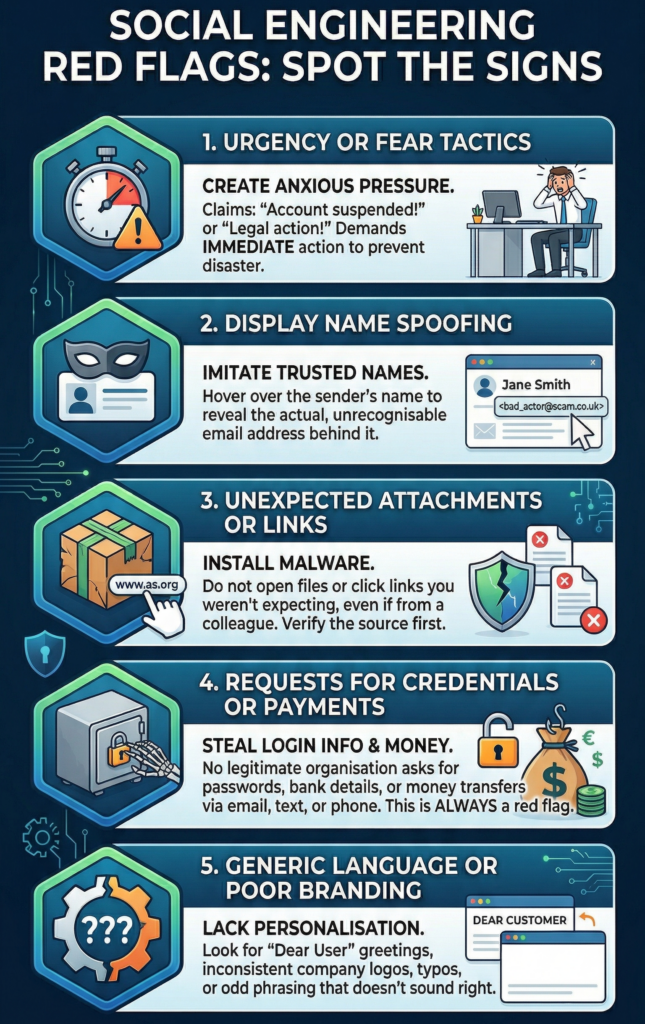
Addressing the threat of social engineering requires a layered approach that treats your people as your strongest asset. At Assure Technical, we focus on three core pillars to help UK businesses close the gap between awareness and action:
Firewalls cannot stop a staff member from clicking a link, and email filters cannot teach a Finance Manager to question a “boss” on the phone. That responsibility – and opportunity – lies within your organisational culture.
If you haven’t recently tested how your people and processes respond to a real-world social engineering scenario, you are only seeing half your risk profile.
Is your team ready for the next evolution of fraud?
We help UK businesses find out – safely, ethically, and with clear, jargon-free recommendations for improvement.
Book a quick Cyber Security Review Call to start building your human firewall today.

Get in touch with our expert consultants for straight-talking, jargon-free technical security advice.